
Brain Enhancement (BE) Mindful Therapy® Workbook: Volume III
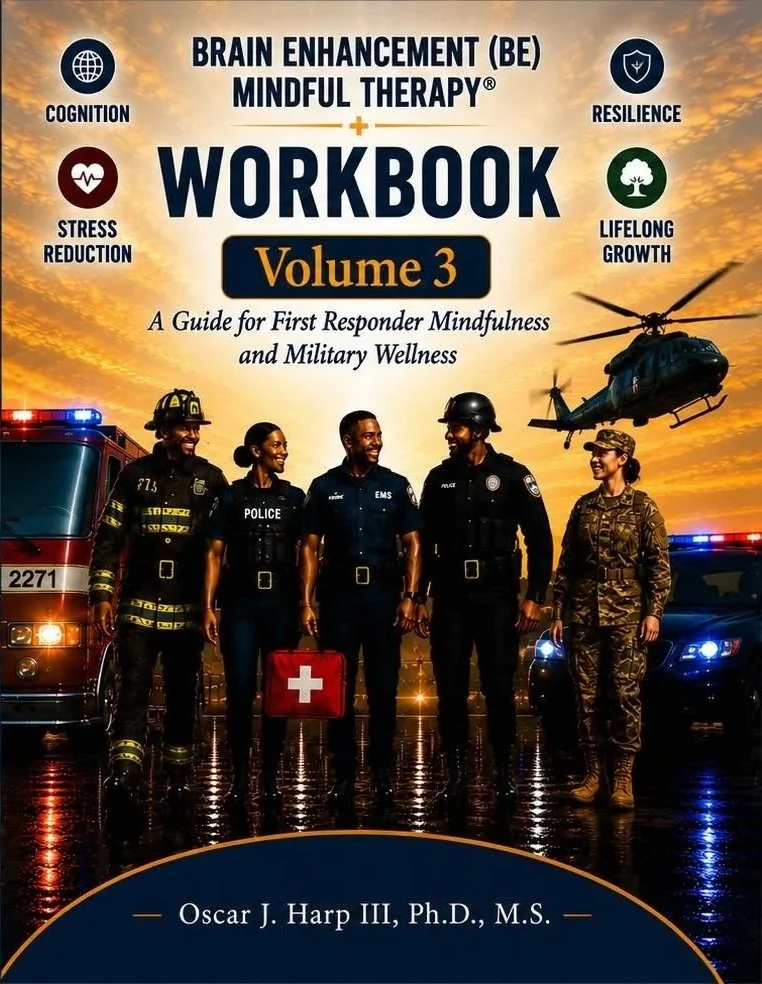
Brain Enhancement (BE) Mindful Therapy® Workbook: Volume III
Volume III of the Brain Enhancement (BE) Mindful Therapy® Workbook applies the BE-MT system to first responders, military personnel, police, and others who serve in high-intensity professions. These individuals operate in environments where pressure is constant; decisions are immediate, and the consequences of those decisions may be life-altering.
Courage, discipline, responsibility, and service define these professions. They also place extraordinary demands on the brain and body. Repeated exposure to emergencies, danger, uncertainty, human suffering, and high-stakes decision-making can challenge even the most prepared and resilient individuals. Over time, the cumulative effects of these experiences may affect attention, emotional regulation, physical health, sleep, relationships, judgment, and the ability to recover from stressful events.
Volume III is part of the three-volume Brain Enhancement (BE) Mindful Therapy® (BE-MT) workbook series. It builds directly on the foundation established in Volume I and the specialized applications introduced in Volume II.
Volume I presents the core principles of BE-MT, including neuroplasticity, chronic stress, Grounding Objects, Cognitive Impact, Mindful Exercise, and the development of the Possible Positive Self.
Volume II applies these principles to important areas of life, showing how BE-MT can work in health, relationships, education, workplace functioning, aging, and athletic performance.
Volume III proceeds by applying the same structured system to environments that expect stress.
Applying BE-MT Under Pressure
Brain Enhancement (BE) Mindful Therapy is not a traditional mindfulness-based intervention model. It is a structured, neuroplasticity-based system designed to strengthen the brain’s ability to adapt, regulate, recover, and perform under pressure.
While many mindfulness approaches emphasize stillness and passive awareness, BE-MT uses a more active form of mindful brain engagement. The model integrates attention training, cognitive enrichment, physical movement, positive identity development, and purposeful repetition to encourage meaningful and lasting change.
The BE-MT system is organized around four interconnected components:
Grounding Objects (GO) to direct, stabilize, and retrain attention
Cognitive Impact (CI) to strengthen encoding, awareness, and mental processing
Mindful Exercise (ME) to engage the brain-body connection through purposeful movement
Possible Positive Self (PPS) to reinforce identity, direction, resilience, and future-oriented thinking
Together, these components form the functional BE-MT loop:
GO → CI → ME → PPS
In high-intensity professions, this loop becomes a practical framework for maintaining attention, managing stress activation, strengthening cognitive and emotional regulation, and supporting recovery. The goal is not to eliminate the natural stress response. In dangerous or rapidly changing situations, stress may help prepare the individual to act. The goal is to prevent repeated activation from becoming a chronic pattern that interferes with health, performance, judgment, relationships, or quality of life.
Preparation, Performance, and Recovery
Volume III focuses on three essential areas: preparation before high-intensity events, performance during demanding situations, and recovery afterward.
Before an event, BE-MT procedures may help individuals prepare their attention, regulate unnecessary tension, and strengthen mental readiness. During an event, the model may support present-moment awareness, purposeful action, and the ability to redirect attention when distracted or emotionally overloaded. After an event, BE-MT practices may assist with decompression, reflection, physical release, and the transition from heightened readiness to a healthier state of recovery.
Recovery is not a sign of weakness. It is an essential part of continued readiness and effective performance. The brain and body require opportunities to process intense experiences, reduce accumulated stress, and restore balance. Without adequate recovery, stressors may continue to build while the activities and experiences that help a person de-stress remain insufficient. This imbalance may contribute to stress-load deficiency, a central concept within the BE-MT model.
This volume helps readers identify the demands placed on them, recognize signs of accumulated stress, and develop individualized strategies for restoring balance. It also encourages readers to examine how occupational stress may affect life outside the work environment, including sleep, physical health, communication, family relationships, emotional availability, and personal identity. Structured exercises, worksheets, self-assessments, clinical protocols, and visual learning tools guide readers to translate BE-MT principles into practical procedures for use before, during, and after high-intensity experiences.
The workbook also continues the practice of Let’s Mindergize, which combines aerobic exercise, mindfulness, positive affirmations, and visualization. In high-intensity professions, these methods are used to support attention, mental fitness, emotional resilience, physical engagement, and positive neuroplastic change.
I developed BE-MT from decades of clinical experience, research, and work with individuals facing psychological, behavioral, physical, and stress-related challenges. One of the most important lessons from this work is that we should not understand resilience as the ability to endure unlimited stress without consequence. True resilience includes the ability to prepare, perform, adapt, recover, and seek support when it is needed.
Volume III provides first responders and military personnel with a practical framework for strengthening attention, managing the cumulative effects of stress, supporting recovery, and protecting the mental, emotional, and physical resources required for continued service.
This workbook does not remove the demands of high-intensity work. Instead, it provides structured tools intended to help individuals meet those demands with greater awareness, preparation, adaptability, and resilience.